Next Home Project: Closets

It is exhausting. We haven’t had so much as a week since finishing the dining room floors and still await a weekend delivery of plaster to take care of the walls. Then, last night our to-be-built-in closets arrived (we designed them to fit either side of the chimney breast in the bedroom with a built in chest of drawers between that will also serve as a tele stand up there).

On deck: sealing, staining, and building. Neverending.

Dining Room Project Part 3

Mid-September, we tied up some pre-tiling loose ends to the dining room project.  When last we reported, the limecrete was still being kept damp and none of the new electrical components were attached to mains.  Since then, the bedding sand for the tiles arrived, we have three more pairs of sockets around the rooms, the anchors for levelling lines have been mounted on walls approximately 4 inches over the final grade, and we have marked the slab with important information and commentary.

So far, I have not pulled a Sideshow Bob face smack with the landscape rake.  So far….

We responsibly marked the approximate location of the gas line and left clues to the date.

We worked slowly.

I vastly underestimated how much limecrete materials I needed to order or just how exhausting it was going to be to implement. So, the underestimate allowed a couple of weeks between the first and final tiling while awaiting the second order (there would be one more…).

We also plan to have the hearths and fireplaces in, if not also the mantles, by Christmas.

By the time we finished, we had 18 remaining tiles. I ordered enough for 25m2 (for 23m2 of floor) but there was significant breakage along the way.

A couple more weeks passed and we sealed with boiled linseed oil then grouted. We set aside two days to do this and it took every waking moment of 5 days.

There was still more to do. The tiles were ‘handmade’ and not at all flat but also not at all curved uniformly. Our best application of the lime adhesive still left us with an unacceptable amount of lippage which we lived with for a couple of weeks until the rented floor sander arrived.

If you ever decide to sand a terracotta floor, get a good respirator with several replacement filters and tape off every entrance to the room — even the smallest hole will result in dusting everything in the house. But, we can call this one “done” despite still needing to replaster the walls, install skirting boards, fix the electrical outlets to the walls, and install a hearth, fireplace, and mantle. And on and on….

Radiators and Ceiling Fans

Modern radiators are efficient, easy to maintain, and ghastly.  We found a manufacturer in Coventry that makes cast iron ones from period casts and, while we couldn’t afford exactly the ones we wanted, we did pretty well buying some clearance priced display models.  The big one up top is late Victorian for our living room and the two below are for the bedrooms.

They weigh a bit more than we counted on and at a meter long they posed the problem of how to move them upstairs whilst keeping them level (the fittings between segments are somewhat fragile).  I built a rig for the trailing end to balance on a stair and we moved upward one step at a time:

The geotextile on the floor is from before we even started the dining room floor refurb, which post is pending a final photo.

As mentioned in the wood floor post put up earlier, we delayed work on it because of things like the radiators that required pulling up boards left undisturbed for 113 years.

The living room heating needed to be rerouted and the bedrooms needed shorter and longer sections put in.

When installed, the previous radiators went over some dreadful wallpaper:

As did the ones in the bedrooms (Jackie really likes this one, though):

I was especially impressed with how well the device was centred on the window:

Rated at a bit higher thermal output, the smaller heater is just under the windowsill where a cat, when we get one, will certainly spend a lot of time.

Global warming means that we might get more than 5 or 6 days of Summer heat that merit some extra cooling. So, in our bedroom and the living room we installed ceiling fans. I needed to put in some reinforcement before mounting the beasts which involved more intrusion into the floor:

It works well and despite being fairly modern it seems to go with the mid-century furniture we hope to collect once we finish up all the detail work around the place.

Wood floors, continued

The original wood floors in The House were mentioned long ago and we have put off tackling them in deference to everything else that we’ve been working on.  We finally took the plunge and approached Walker’s Reclamation Yard for 250 linear feet of boards similar to ours to replace damaged ones.  Then, it was as simple as hiring a drum sander and going at them with a vengeance (and 24 grit sandpaper to start, walking through four increasingly fine grades).  Above, you’ll see hemp cord filling large spaces which we spackled with the finest sawdust mixed with wood glue before a final sanding.

Bedrooms, Living Room and 1st floor landing all came out lovely.  We sealed them with linseed oil which will protect them until we can do a final stain and lacquer, but the honey glow they have in the interim is quite satisfying.

Dining Room Project Part 2


We left the dining room project last weekend with almost everything shoved in other rooms, the original tiles stacked on a pallet, and the rammed earth subfloor covered with geotextile so the bottoms of our feet sould stay clean.  Wednesday, we started digging.

First, we needed to know how much to dig.  I wanted to string some taut cord to act as a datum from which we could measure the depth anywhere in the project.  I asked the DIY store guy for some string to do this and he started pulling out a length from a dispenser.  “No, more like the cord you use when you want bricks to follow a line.”

“Oh,” he said, “you want brick line.”  Whatever, I thought, but the package actually says, “Brick Line.”  I’ll never fully understand the English language.

We knew there was a gas line and a supply and return line for the central heating.  We also knew approximately where it was but opted to use a small gardening spade to uncover around it as if we were on an archaeological dig.  In fact, that’s exactly what it was but save for a few nails no treasure was uncovered.

The concrete screed laid over the former veranda had to go, as well.  Not only was it going to be impervious to vapour on its own but it was lined beneath with a thick, plastic sheet.  This almost certainly explains the damp problem over by the doorway where the screed ends and the first path for ground moisture to exit the covering begins.  But, we couldn’t take out all of it due to the aforementioned gas line being embedded in the screed, as well.  The hammer drill got as close as I felt comfortable, though, and the improvement to damp control should still be immense (6½ of those 7 square metres are now, once again, breathable).

The dig finally complete after two, long days, we relaid the geotextile and covered it with a layer of perlite a few centimeters thick them covered THAT with another layer of geotextile.  This acts as an insulating layer that is one improvement over the original rammed-earth-only version of the subfloor.

Next in, the heating pipes.  We laid out everything roughly where we needed it and a few extra lengths to be sure.  I cut the supply and return lines to steer them down into the hole and away from the gas line but once I started connecting it back up was interrogated by the spouse: “Are you sure soldering that close to a gas line is okay?”  I assured her the gas was inside the pipe, then continued to fit the plumbing.

It is a tradition to place items in a big building project to mark that you were there.  I thought that it was probably not enough just burying all these other pipes, so I also packed up this one (next photo), put it and a lighter in the baggie along with my receipt from the builders’ supply yard and a 2020 coin, and wrote on the back of the receipt

No stems, no seeds
That you don’t need.
Acapulco Gold is…
One bad ass weed.

Future home owners doing some renovation may well find this and try to date the artefact either from the receipt (2020) or the jingle (early 1970s).  Knowing it is there makes me smile.

It was nearly 10 pm when we finally repressurised the central heating to check for leaks, finding two — one at a capped stub almost inpossible to reach, the other on the 22mm supply pipe which was now wet again and would be impossible to solder.  I scrambled around the tools and eventually found several compression tees that reduce from 22 to 15mm; capping two short 15mm pieces to fit there, we now had unions to repair the leaky section with a new splice.

The second leak test at 1am went better and we were able to shower up an hour later.  Long day.

Friday, we started pouring and continued for the next three days one mixer load at a time.  The aggregate was a mix of perlite and sharp sand and the consistency was probably too soupy for structural use but not so much that it acted like self levelling compound.  This was Jackie’s introduction to the world of the mud monkey, so I gave her tasks like poking the mud with a rod to get it to spread (which concept evaded her…l’et it spread where the vibes take it, not where you think it needs to go,’ etc).

The next photo shows some of the first day’s pour.  We had to put in some bridges to get over the slow setting mud.

The one injury from this effort was due to stupidity on my part.  Cleaning the pipes for soldering with steel wool left me with microscopic cuts and small embedded steel fibres in my fingers.  I didn’t even know these were there but the lime in the crete sure did reacting slowly but violently with meat and metal to leave my hands pitted with abscessed wounds.  I once had a cut cauterised in the field which was painful enough on its own but then the open bit became a 3rd degree burn instead of the flowing gash; the pain lasted days, very similar to the 18 smaller pleasure points mapped all over my hands.  Good stuff.

For now, we have combined the two rooms to a nearly open plan, bought back more space with the removal of two radiators (both of them modern and quite ugly models), and restored and improved on the original damp-handling capacity of the house.

Limecrete doesn’t cure the same as regular concrete.  Instead of fixing CO2 from the air, the crystal lattice forms mostly with water.  If it dries out, it will never really achieve its full strength so for the next week or so we have to drag the garden hose in and wet the surface thoroughly twice a day.  And, we can’t use the underfloor heating for 3 weeks (some say 4).  Let’s hope for a warm early Autumn.

Next up: re-tiling.


Dining Room Refurbishment and Extension, #1

The WC and Coal Hold were the old bath when we moved in and are now the laundry and cloakroom.  Blueprint dated 29 October 1907 courtesy Sandwell Archives.

The room we use as the dining room was originally designated the kitchen in the first houses on the street with OUR kitchen (being the scullery at that time) separated from the main house by an open air veranda with 6 feet between the two.  I’ve seen a few other ways this veranda has been sealed from the elements and incorporated into the houses along this street and ours is one of the least readily usable versions, merely enclosed across the width of the house (see the red line) then connected to it by removing the walls from old kitchen / current dining room.  We aimed to change that by

Levelling up the two floors with a breathable sub-layer
Replacing radiators with underfloor heating (UFH)
Replacing the quarry tiles with new terracotta

The saga began with the arrival of ½ tonne of natural hydraulic lime grade 5 (NHL5), “eminently hydraulic” compared to the “feebly hydraulic” NHL2.  It is used in preserving the breathability of historic buildings, essential to the damp control of — in particular — turn-of-the-last-century homes like ours.  From different vendors, I also got 500 litres of Perlite and a tonne of sharp sand.


This original quarry tiles were layed directly on “rammed earth” which consists of the backfill from the original construction site. This was entirely intentional for control of ground moisture and had been common practice for centuries at the time.  Not too many years after this house was built, the state-of-the-art shifted to lining the subfloor with something completely impermeable so that the moisture would be driven to the edges where a vent to atmosphere would handle the moist air.

Whilst clearing the LR flooring we found that the screed in the veranda is lined with thick and quite impervious plastic, thereby explaining the damp in the corner.

So, say you didn’t know this (or in the case of most flooring contractors, didn’t care): to put down a carpet or lino or laminates you would first lay down a sheet of polythene which would block the moisture from rising through the new floor thereby driving the damp to the walls.  Glazed ceramic tiles and porcelain tiles and most modern tile adhesive does precisely the same.  It took only hours for us to see an improvement in some of the walls after we cleared the ill-advised treatments from the otherwise breathable floors back in the spring.

The tiles removed

The quarry tiles we removed are VERY thick — 38mm or 1½ inches — but the drop to the veranda is 55mm at the south end and 45 by the door (which we assume help drain this open air interstitial area back in the Olden Times).  So there will be some excavation to do just to bring the current dining room to grade let alone to create layers for insulation, mechanical stability, and as a bed for the new quarry tiling.
For now — the cement mixer arrives Monday and I have Wed-Fri off to get started on the next steps — we tidied the de-tiled, soil floor and covered it with geotextile (which is also the first layer of the NEW subfloor, so we can put this directly on there once we dig things out).  The tiles arrive in 2½ weeks, giving us time to prep and cure the limecrete layers and enjoy having all the stuff from both chambers stacked in our living room.  Stay tuned.

Wood plank prep, new electrical connections, and wired internet

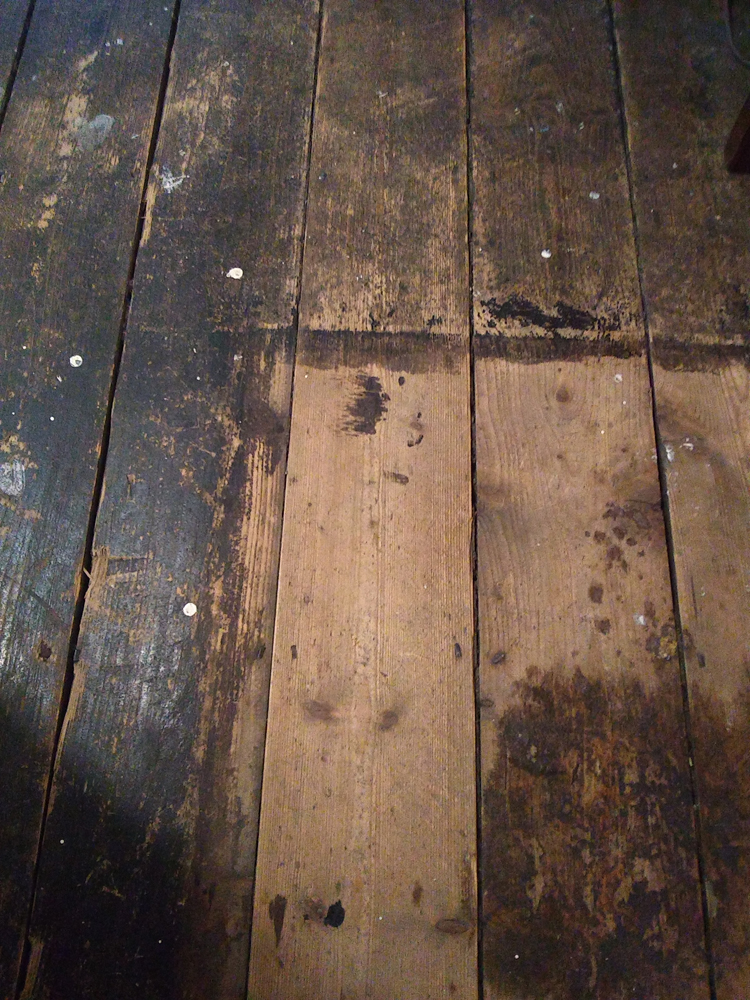
A lot of the wood flooring in our house is painted with bitumen as was the fashion in Edwardian times.  Most of it is only around the edges to create a dark framework for the rug that would be central to the room.  For us, however, it will gum up the sander fairly quickly so we are attempting to flip as many of these planks as practical ahead of hiring the sander in a few weeks.

The old gas pipe (NOT Jackie’s pet name for me) awaits a Gas Safe plumber to disconnect it.

At the same time, we have an opportunity to rewire the house and move some of the radiators (we just ordered some new cast iron ones made from old, original, contemporary-with-the-house moulds).  They will arrive in a few weeks so I’ll have to dive back under the boards at that point to solder new pipework but at least the groundwork is now laid for that.

The bitumen coated floors are dry and worn but flipped they are only dry and awaiting sanding, stain, and varnish.

Meanwhile, the house only has a bare minimum number of electrical outlets all in inconvenient locations so that the rooms have been cluttered with extension cords since our arrival.  This is no longer the case.

The landing at the top of the stairs is a de facto junction box containing all the cables from 12 decades of the house.  Some are thin, bare wires!  Others were obviously an improvement on these but all the insulation crumbles upon handling.  A third batch appears to have been replaced in the last 30 years or so with the ones we currently (ha! . . . pun) have.  We are replacing all the conductors we find with overrated lines (26 – 34A, 2.5mm² wires for 6A and 16A breakers and 35 – 46A, 4mm² wires for 32A ones).

While at it, I sent the satellite cables under the floor as well thus shortening them by almost 20 meters to a mere 8m (we picked up a couple of extra channels with the increased signal strength).   I added a new quad LNB to the dish so we can have a tele in the bedroom (a sign of age, true, but I still haven’t succumbed to the Laz-E-Boy recliner with built in cupholder … yet).

The pipe is an old, disconnected gas line that went to gas lighting and radiant heaters back in The Olden Days

Finally, we also wired the house for the internet using CAT6 cables — and, yes, I know they are already superceded by CAT7, but there is really only negligible difference to see between these and CAT5 for our purposes which do not involve either gaming or Bitcoin mining.  The digital service line to the router/wifi modem also took a dive under the boards and the equipment was moved to the larder under the stairs.  We now have web sockets in our bedroom and living room for the tele’s streaming services and in the living room and office for computers; anywhere else, it is back to WiFi.

Tiles to Add to the House Archive

This week’s fireplace removal held some surprises including the old hearth made from some delicate (china clay) tiles.  The glazing — but not the paint — peeled away with the cement render in most cases and many of the tiles disintegrated so we’ll have to replace them when we get the cast iron fireplace inserts of our dreams (still ONLY in our dreams).

The glazing from the tiles that came loose is still integrated on the levelling render some oaf poured over it decades ago.

But, the nicest one will eventually join other bits we recovered from the house’s history — like the wallpaper remnants and the various bits of old lino.

An intact — save for the glazing — hearth tile above the broken one from the header photo of this post, below. There are a couple near the chimney that still have glazing on them and one of those can go to our hoarders’ pile.

It is definitely an archive we are making and not a revisionist history display, though.  I am even keeping a mottled tile from the most hideous fireplace — if not on earth, then — in the house:

Naturecraft is stamped on the back…a clue to the mystery of what company must be held to account for this crime against architectural detailing.


Fireplace Refurb #2

We took off work from Wednesday till after the Bank Holiday to get back into some major refurbishment jobs in the house.  One depressingly ugly bit in particular had to go (soon to be joining the other hideous fireplace taken out before the lockdown).

The hearth broke free with some manual hammer and chisel action but to break it into pieces the two of us could carry took the rotary hammer drill:

Back to the chisels and crowbar, we managed to tilt the mantle off the chimney exposing the front and the insulating wool I stuffed into the chimney until we can find the right insert for the refurbishment.

We’ve been busy but the marking on the back, we hope, will give us a clue to the date and location of manufacture (J thinks the 30s, I think the 60s, we both think nearby).

Perhaps as near as Wednesbury?

Clearing the rubble, some of the original hearth was exposed beneath 6 inches of render:

More of them were broken or permanently attached to the rubble than not.  The last photo, below, shows the state of things at the end of Wednesday (before we salvaged what we could of the remaining, stuck tiles).  We’ll try to find an entire set similar to this one to replace this old hearth but for now we are luxuriating in extra space and the removal of angst the old, ugly fucker imposed.

Here it is today:

Kitchen Refurb #2

The kitchen, laundry, and WC are so interconnected that working on one impacts the others.  We had taken up some porcelain tile at the entrance to the laundry revealing 1908 quarry tiles in good shape under a layer of cement render.  The next step was to pull up the rest of the kitchen tiles to assess what really lies beneath.

They looked awful but we were determined to see them close to original.  Some muriatic acid was recommended to etch away the stains and loosen the larger blobs (note, this was a couple of months before the brute force method I employed on the dining room quarry tiles).

Still, there is much to do (cabinets; plaster walls and ceiling; put in an access hatch to the ceiling crawlspace; level the subfloor; and, install underfloor heating, sink, stove, dishwasher) but it is all on hold until we finish the wood flooring, built in closets, and subfloor heating in the dining room.  Baby steps.

Design a site like this with WordPress.com
Get started